
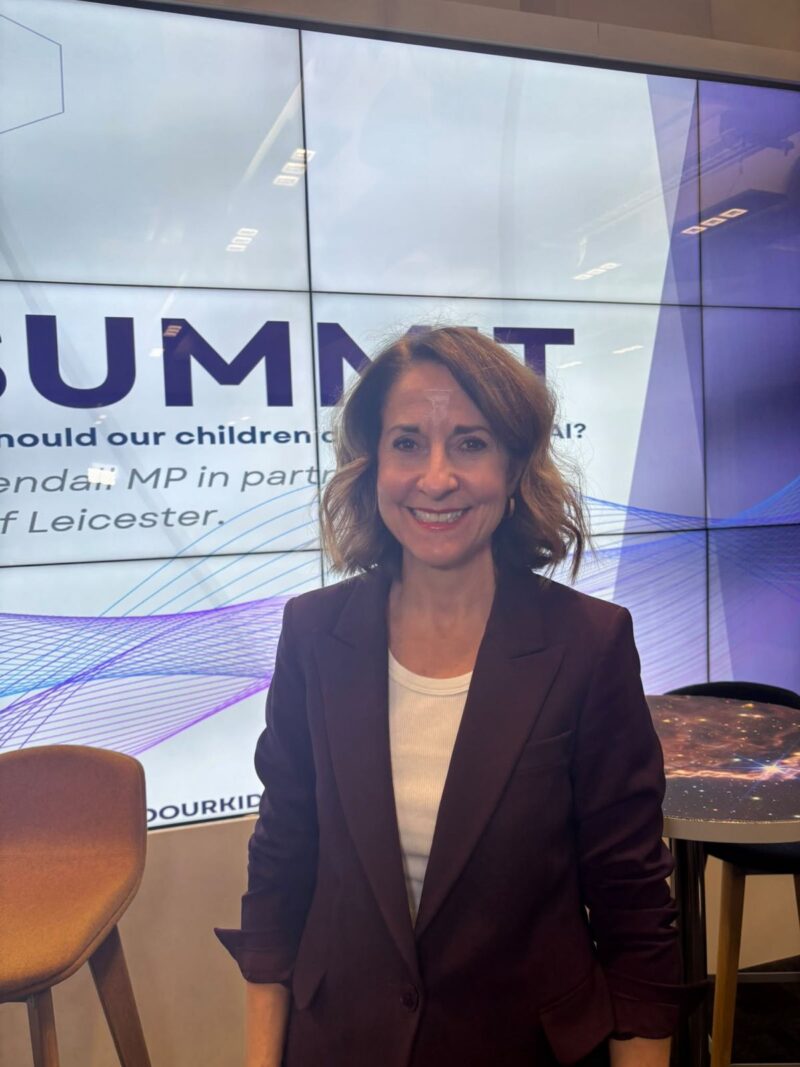
“What should our children do in a world of AI?”
Speech by Rt Hon Liz Kendall MP
Leicester AI Summit, 19 November 2026
INTRODUCTION
What should our children do in a world of AI?
It’s a question I hear more and more.
From parents, who worry about what to tell their kids when they ask for advice about the future.
From teachers, grappling with how AI is changing the way children study and learn.
And it’s a question I increasingly hear from young people, in my own family as well as my constituency.
What subjects should I take? Should I even think about going on to do languages, history, computer science or the law if AI can now do it all?
And is any of it worth it anyway, if AI is going to take all the jobs?
And when I speak to employers … large and small, from the private and public sector … they’re thinking hard about the implications of AI: how it could boost their productivity, grow their business, improve their services.
And what that means for their workforce and skills.
Today’s summit is about bringing all these issues together in one place, because … even if we don’t know where AI is going to end up, or the answers to all these questions … we have a better chance of figuring out the best way forward if we work together.
Throughout the day we’ll be hearing from Leicester’s schools, colleges, universities and employers … and crucially from young people themselves … with one clear purpose in mind:
How can we better prepare young people for a world of AI so that they and our city can thrive?
What does AI mean … not only for the skills young people will need in future but the more fundamental question of what our system of education is for?
What are the implications for schools, colleges and universities? For employers?
And – crucially – for Government too.
I have always believed everyone should have the chance to fulfil their potential: no matter where you’re from, what your parents do, your gender or the colour of your skin.
Because that is how we succeed as individuals and as a country.
AI offers huge opportunities to unleash human knowledge and potential.
It also brings risks, including widening the inequalities we already see in our society that are holding too many of us back.
But AI is here. And it is not going away.
So the choice isn’t between having AI or not. It is a choice between shaping AI to win for our city and country, or being left at its mercy or whim.
I believe we can shape a better AI future … but only if we work together.
And that is what today is all about.
THANK YOU
I think we are the first place in the country to hold such an event. And that wouldn’t be possible without some key people who I want to thank this morning.
First, Nishan, Paul, Rowena and their brilliant team at the University of Leicester for hosting us, and feeding us, in your wonderful Space Park.
Leicester university has always combined being at the cutting edge of knowledge and technology with widening opportunities for young people. And today is no exception.
The second person I want to thank, who unfortunately couldn’t be here, is Daniel Susskind
His wonderful book “What should our children do?” to flourish in the age of AI in part inspired this event. It’s a great read that I highly recommend.
Thank you to all the panel speakers who have given up their time to be here today.
In particular, the young people who have agreed to share their views. You are what today is all about.
Last but by no means least – a massive thank you to my amazing team: Sarah, Millie, Rhea, Alisha and Hardeep. Its no mean feat putting together something like this. I’m really proud to work with you all.
SETTING THE SCENCE
I want to briefly set the scene for today’s discussions by making three main points.
An uncertain future
The first is that the future is uncertain.
The biggest uncertainty is the path AI will ultimately take.
Will it lead to what some call “recursive self-improvement” – or “super intelligence” – where machines learn by themselves and potentially become more intelligent than the most intelligent person ever, in every single sphere?
Or will AI follow the path of other general purpose technologies like steam, electricity or the internet?
Either path has big implications for jobs, skills, our economy, society and arguably humanity as a whole.
One thing we do know is that AI is already changing the world of work. And that’s not just in so-called white colour jobs but manufacturing and retail too.
Businesses and public services like the NHS tell me AI is helping to free up people’s time from more mundane and repetitive administrative tasks to focus on more productive or creative work, and human interactions.
We know that AI is already creating new jobs and businesses … and in future will create even more, including new occupations that we can’t yet imgaine.
But we need to be honest too.
Some jobs will decline. Others will disappear. That has always been the case with the introduction of general purpose technologies from the industrial revolution onwards.
I know people are particularly concerned AI’s impact on entry level jobs, compounding the challenges many young people already face getting on the first rung of their career.
That’s why, when I as Technology Secretary, I launched an “early careers alliance” between employers and trade unions – starting in the digital and technology sector – to look at how entry level jobs can be reshaped to continue to bring in new talent, which businesses will always need.
But there is more we can and should be doing on this, which I hope we will cover later today.
In the face of all this change, the central question is: how do we prepare young people for an uncertain future?
In his book, Daniel Susskind reminds us when we were all told coding was the new skill that everyone needed … and yet coding is now precisely what AI does extremely well.
His point being, we cannot future proof skills or jobs any more than we can accurately predict the future.
Instead, he argues we should focus intensely on basic human cognitive skills – literacy, numeracy and critical thinking – so that the next generation can learn whatever more advanced skills do turn out to be most valuable in years to come.
Interestingly the employers I speak to make similar points.
The skills they are increasingly looking for are problem solving. Rationality, critical thinking.
Work ready skills like reliability and the ability to communicate.
The things machines can’t do like human empathy. The ability to build relationships and trust.
And above all flexibility.
The other thing employers increasingly want are AI skills themselves.
I’m sure the whole question of whether and how children should be taught to use AI will be a focus of this afternoon’s session.
But my view is this: we cannot pretend this technology doesn’t exist. We must teach the next generation to use AI effectively, wisely and ethically.
In their fascinating report “Britain’s Greatest Education Opportunity Ever” Anthony Seldon and Tim Bunting argue; “we cannot arrest the rise of AI, but we can refocus our schools on human flourishing: developing uniquely human attributes which will maximise the opportunity of our young people to use AI well, rather than to become over dependent on or infantilised by it.”
I think that makes a lot of sense.
But what does it mean for the curriculum? For our schools, colleges and universities? And for Government, especially the Department of Education?
Young people’s experiences and views of AI
This brings me to my second point, which is I think that young people are crying out for more help and support to prepare them for this uncertain AI future.
We will hear directly from young people in Leicester later this morning.
But across the world we see that whilst AI use is at an all time high, trust is declining… and that’s particularly the case amongst young people.
In September, a study of 37 countries by the Pew Research Center found that young people
… are far more aware of AI
… are especially likely to have mixed feelings about it (both excitement and concern)
… that concerns are rising
… and that young people are far more likely to say AI will negatively impact jobs.
A poll of 4,000 young people in England by Public First – who I’m delighted have joined us here today – makes for fascinating reading.
87% of 11 to 24 year olds now say they have used an AI chatbot or AI tool.
But there are significant differences between different groups. Whilst 92% of under 25s in socio economic groups A and B have used AI this drops to 79% of those in groups D and E.
I think it is particularly worrying that 1 in 5 young people who are not in education, employment or training have never used AI at all …
… because it risks making the barriers to work for young NEETS even greater in future, than they even are today.
And when it comes to young people’s views about the education system, there is widespread concern.
I’m somewhat nervous saying this, considering all the educators in the room, but the poll found …
… 4 in 10 young people think AI has made school less important
… a quarter say AI has made university degrees useless
… and only 1 in 10 think schools and universities preparing them for future.
I know that our schools, colleges and universities are grappling with this technology – on top of all the other very real pressures you face.
But the pace of change with AI is dizzying.
And I think people’s individual use and experience of AI is running ahead of some of our institutions, policy makers and government.
And that urgently needs to change.
Leadership
This brings me to my final point which is about leadership.
My time as Technology Secretary showed me the huge opportunities that AI brings.
To grow the economy. Create good jobs. To innovate, discover new drugs and treatments, and so much more besides.
But it also brings very real risks. And whilst much of the recent debate has understandably focused on whether AI will end up killing us, arguably the more pressing concern is the impact of AI on jobs and opportunities – especially for young people.
But we are not powerless in the face of this new technology.
We do not have to leave whole communities, generations or industries to cope on their own, as we have all too often seen in the past.
We can decide, and collectively we can act.
And the uncertainty we face makes good leadership even more important.
In our schools, colleges and universities.
The managers in our businesses, and our public services.
And yes, our leaders in government too.
I’m delighted that Kanishka Narayan, the AI Minister is speaking to us this afternoon.
The cross Government AI taskforce, which he co-chairs, has a vital role to play.
I believe it should put education and skills front and centre.
But we need to go much further.
AI should be a top 3 priority in the Prime Minister’s forthcoming 10 year plan, with a clear strategy to upskill the nation.
Every single department should have a named and accountable AI minister responsible for thinking through the implications for their department and developing a clear strategy.
Nowhere is this need greater than in the Department for Education. Because that is where the future of our country will be forged.
CONCLUSION
I want to finish with a couple of stories from my visit to Silicone Valley when I was Techn Secretary.
The first was to an amazing high school, that had thought deeply about AI and how it should and shouldn’t be used.
One of the students there told me that in the school she used to go to they banned AI “so we just used it to cheat”.
But she said “In this school, they teach us how to use AI responsibly, to deepen our knowledge. How to judge whether what it tells us is true. And keep a focus on staying human too.” Wise words indeed.
And the second was what I learnt from my visit to San Jose state university, an incredible institution with 40,000 students
The President – Dr Cynthia Teniente-Matson – is a formidable, incredible woman.
She said every single faculty had been asked to think through the implications of AI from the bottom up – not just in terms of which AI skills students would need, in nursing, engineering, business administration, marketing, psychology – but for the body of knowledge students require, and the fundamentals of what education is for.
She told me: “We are in the belly of the beast. And if I fail to prepare young people for the world of AI I will have betrayed a generation of Californians.”
That is what we must do here in the UK too.
Everyone here today can play their part.
I hope our discussions will lead to clear recommendations for action – both here in Leicester, and nationally, including for Government.
So we shape a better future for young people here and across the country.
So let us get on with the job.
Thank you